
Once upon a time, every new car came with a spare wheel and a jack in the boot. Not any more. So if you pick up a puncture, which is actually better - a spare wheel or a foam tyre repair kit?
Carmakers have quietly dropped the spare wheel to save weight, cost and boot space - especially with hybrids and EVs, where every kilo and litre of space counts. RAC research analysing 313 new models across 28 brands found only 8 came with a spare wheel as standard: around 3%. In its place you'll usually find a tyre repair kit, or nothing at all.
For many drivers a spare wheel is peace of mind. A quick change and you're back on your way, no waiting around - and it works for most punctures, including sidewall damage that a repair kit can't touch.
The obvious cost is space and weight. A full-size spare and jack take up a big chunk of the boot, and that's space manufacturers would rather give back to you (or to a battery). A spare also has to be looked after - it needs to be legal, undamaged and correctly inflated, or it's no use when you actually need it.
Space-savers were introduced to cut down on the room a spare takes up. But treat them as a genuine emergency-only option: you should not exceed 50 mph or travel more than 50 miles before getting your proper tyre repaired or replaced.
Run-flat tyres have reinforced sidewalls designed to support the car for a short distance after a puncture, so you may not need a spare at all. The same limits apply - don't exceed 50 mph or roughly 50 miles - and importantly, a run-flat that has been driven on while flat generally can't be repaired and should be replaced.
A repair kit is usually a bottle of sealant foam plus a small 12V compressor (sometimes combined into one unit). You pump the sealant into the tyre through the valve; as the pressure builds, the foam is forced into the puncture to form a temporary air-tight seal. You then need to drive straight away to circulate the sealant.
A repair kit is a temporary measure: once used, you shouldn't exceed 50 mph or 50 miles, and you should get the tyre properly inspected as soon as possible.
Often, yes. Most foam sealants can be cleaned out so the tyre can be assessed for a permanent repair - but only if the puncture is in the repairable area and the tyre passes a full safety inspection. (See our guide to when a puncture can safely be repaired.)
“Honestly, it comes down to what gives you peace of mind. A repair kit is fine for a small nail in the tread to get you home - but it won't touch a sidewall or a blowout. That's exactly why we set the business up to come to you: you don't need a spare taking up your boot if a fitter can be at your door with the right tyre.”
Self-sealing tyres are built with an extra air-proof layer inside that seals small punctures automatically - often without you even noticing. They're still pricier than budget and mid-range tyres, but as the technology matures we expect to see a lot more of them.
No. Carrying a spare wheel is not a legal requirement in the UK. However, any spare you do carry must be roadworthy, legal and correctly inflated.
No more than 50 miles and no faster than 50 mph. Get your proper tyre repaired or replaced as soon as possible.
Usually yes - most foam sealants can be washed out and the tyre inspected, but only if the puncture is in the repairable area and the tyre passes a safety inspection.
Generally no. A run-flat that has been driven on while flat should be replaced rather than repaired.
Call now for a fast, no-obligation quote - or drop your details in and we'll come back to you.
07772 078 648Real jobs, callouts and behind-the-scenes from the GTL van. Subscribe on YouTube →
Your tyre size is printed on the sidewall of the tyre - a string like 205/55 R16 91V. Here's what each number and letter means.
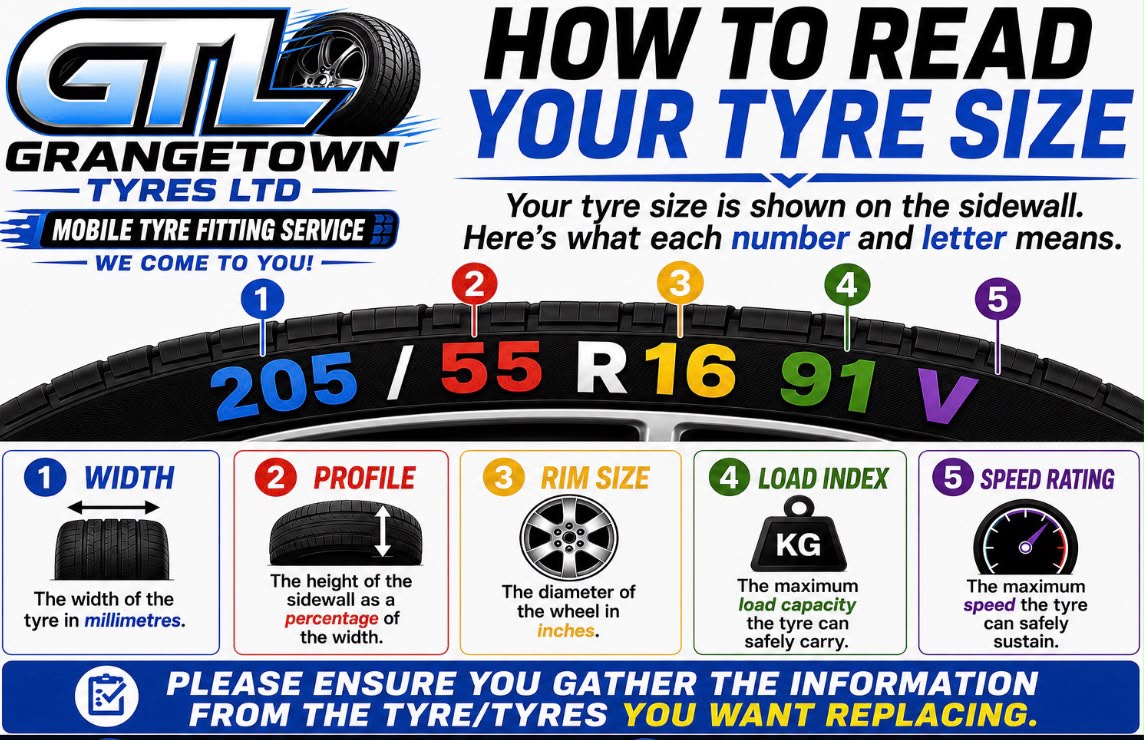
Please take the size from the exact tyre(s) you want replacing - front and rear sizes can differ.